Maths that starts before school does
The soroban has taught children to see numbers for four hundred years. Pibbly brings it to your child’s early learning centre in Brisbane, thirty playful minutes a week, from age three.
- Qualified Early Childhood Teacher
- Registered teacher
- Secondary mathematics teacher
- Abacus sensei, Kyu Level 8
- Current Blue Card
Try it. Make a number.
= 7
Tap the beads, use + / −, or focus the abacus and press the arrow keys.
A pebble of maths. A lifetime of ripples.
Who are you here for?
Three ways into Pibbly. Pick the one that describes you and the rest of the site follows.
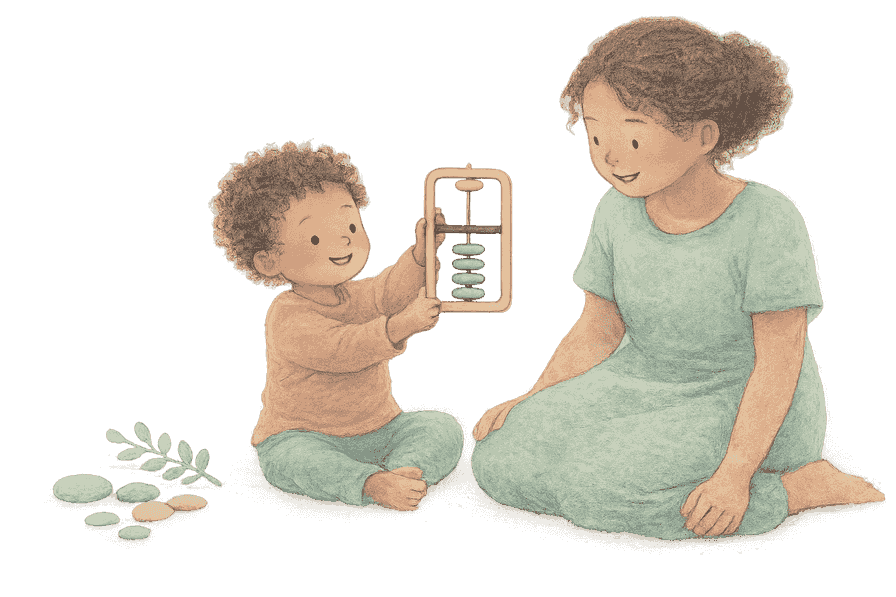
For parents
Thirty minutes a week that changes how your child sees numbers, at their own centre, during the day. If your centre does not offer Pibbly yet, tell us where they go.
For centres & kindies
Numeracy is the enrichment nobody is offering. Pibbly comes to you, runs it, and costs your service nothing. The first session is free.
Assessing providers? The questions worth asking any of them.
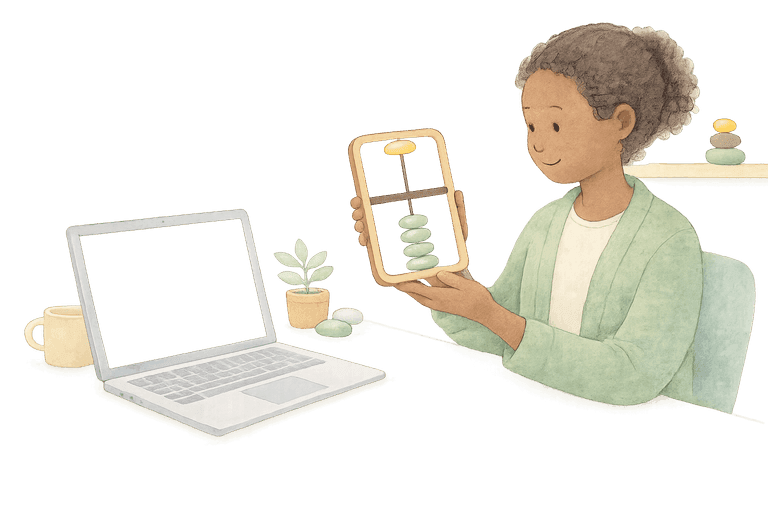
For educators
Online workshops helping educators introduce soroban-inspired number play into early childhood programs. Every educator receives an attendance certificate.
Why use a soroban with a three-year-old?
Because counting is a song, and a number is a shape.
Every number has a shape a child can see and a bead they can move. Five is one gold bead. Seven is the gold bead and two green. Nothing is abstract, nothing is memorised, and nothing needs to be written down. Children stop reciting and start seeing, and that is the difference between a child who counts and a child who understands.
A single-rod soroban: the top bead is 5, each bottom bead is 1. Beads touching the bar are counted.
Who is teaching my child?
A qualified early childhood teacher with a secondary maths background and a current Blue Card. Warm, qualified and grounded in play.
Qualified Teacher-Led
Created by a qualified Early Childhood Teacher, registered teacher and secondary mathematics teacher.
Play-Based and Unhurried
Designed for young children through hands-on, age-appropriate number play.
Grounded in Early-Years Practice
Informed by the Early Years Learning Framework (EYLF) and Queensland Kindergarten Learning Guideline (QKLG), and built on play-based pedagogy.
Blue Card Holder
Pibbly is delivered by an educator with a current Blue Card.
Isn’t three too young for an abacus?
Three is where it should start.
By three, a child can hold a bead, follow a two-step instruction and stay with something they find interesting. They are already sorting, stacking and matching, which is the thinking maths is built on. The one thing they do not have yet is a way to see a quantity. We are not asking a three-year-old to calculate. We are handing them something to think with, two years before anyone asks them to.
How does a Pibbly session work?
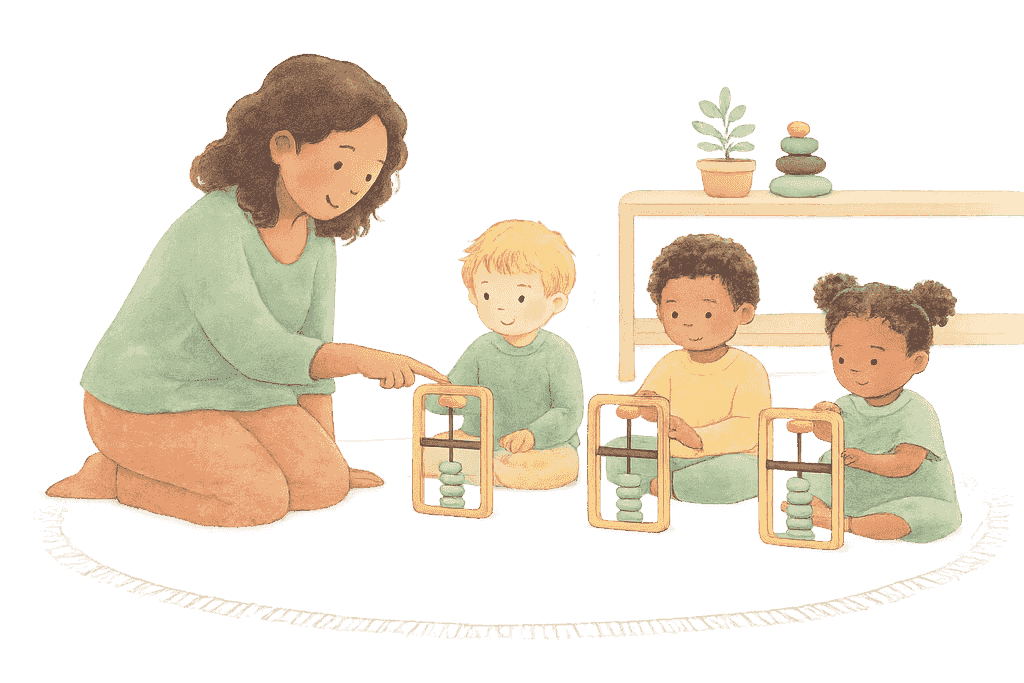
Pibbly comes to your child's centre once a week for a weekly ripple of playful number play. You do not drop off, drive anywhere or add an after-school commitment.
- 1
Pibbly comes to your centre
Pibbly visits early learning centres, kindergartens and schools across Brisbane and South East Queensland, at a time agreed with the centre.
- 2
A calm weekly session
Children attend a short, play-based soroban session during the centre day, full of counting, stories, songs and hands-on number play.
- 3
Progress at their own pace
Every child begins with Workbook 1 and moves through the Pibbly workbooks when they feel ready. Pibbly celebrates progress, not pressure.
- 4
Little practice ripples at home
Simple take-home family play prompts let families continue the learning through playful moments at home.
How much does Pibbly cost?
$20 a session for ages 3 to 5 and $25 for age 6, booked in blocks of four. Pibbly visits your centre in Brisbane and South East Queensland, in small groups of up to 8. Parents enrol and pay Pibbly directly.
Ages 3 to 5
30-minute sessions
$80
per 4-session block ($20 per session)
Age 6
45-minute sessions
$100
per 4-session block ($25 per session)
Every enrolment includes
Pibbly bag · Child-friendly soroban/abacus · Pibbly shirt · Workbook/learning portfolio · Weekly play-based session · Take-home family play prompts
How do you keep my child safe?
Pibbly is delivered by a qualified, Blue Card checked teacher, always within your centre’s own supervision and ratios, never unsupervised. And we never photograph the children in our sessions. Every child you see on this site is an illustration.
A few common questions
What is Pibbly?
Pibbly is a play-based early numeracy program for children aged 3 to 6, running in early learning centres, kindergartens and schools across Brisbane and South East Queensland. Children use a child-friendly soroban to explore numbers, counting and early mathematical thinking through hands-on play.
What age is Pibbly for?
Children aged 3 to 6. Most abacus programs start at five or six. Pibbly starts at three, which is two years before school, because that is when a child can hold a bead, follow a two-step instruction and stay with something that interests them.
Isn't three too young for an abacus?
Three is where it should start. By three, children are already sorting, stacking and matching, which is the thinking maths is built on. The one thing they do not have yet is a way to see a quantity. We are not asking a three-year-old to calculate. We are handing them something to think with, two years before anyone asks them to.
How many children are in a session?
Sessions run in small groups of up to eight children, so every child gets time with the teacher and their own soroban.
Not ready to enrol just yet?
Pop your details in and we’ll let you know as Pibbly comes to centres near you.
Ready to start with a little pebble of maths?
Register your child, invite Pibbly to your centre, or just say hello. We’d love to hear from you.